
Stainless Steel Chain – ISO 606 | 304 / 316 / 316L | 2–32 mm
Als einer der Hersteller, Lieferanten und Exporteure von Ketten der Ingenieurklasse bieten wir Ketten der Ingenieurklasse und viele weitere Produkte an.
Für weitere Informationen kontaktieren Sie uns bitte.
E-Mail:[email protected]
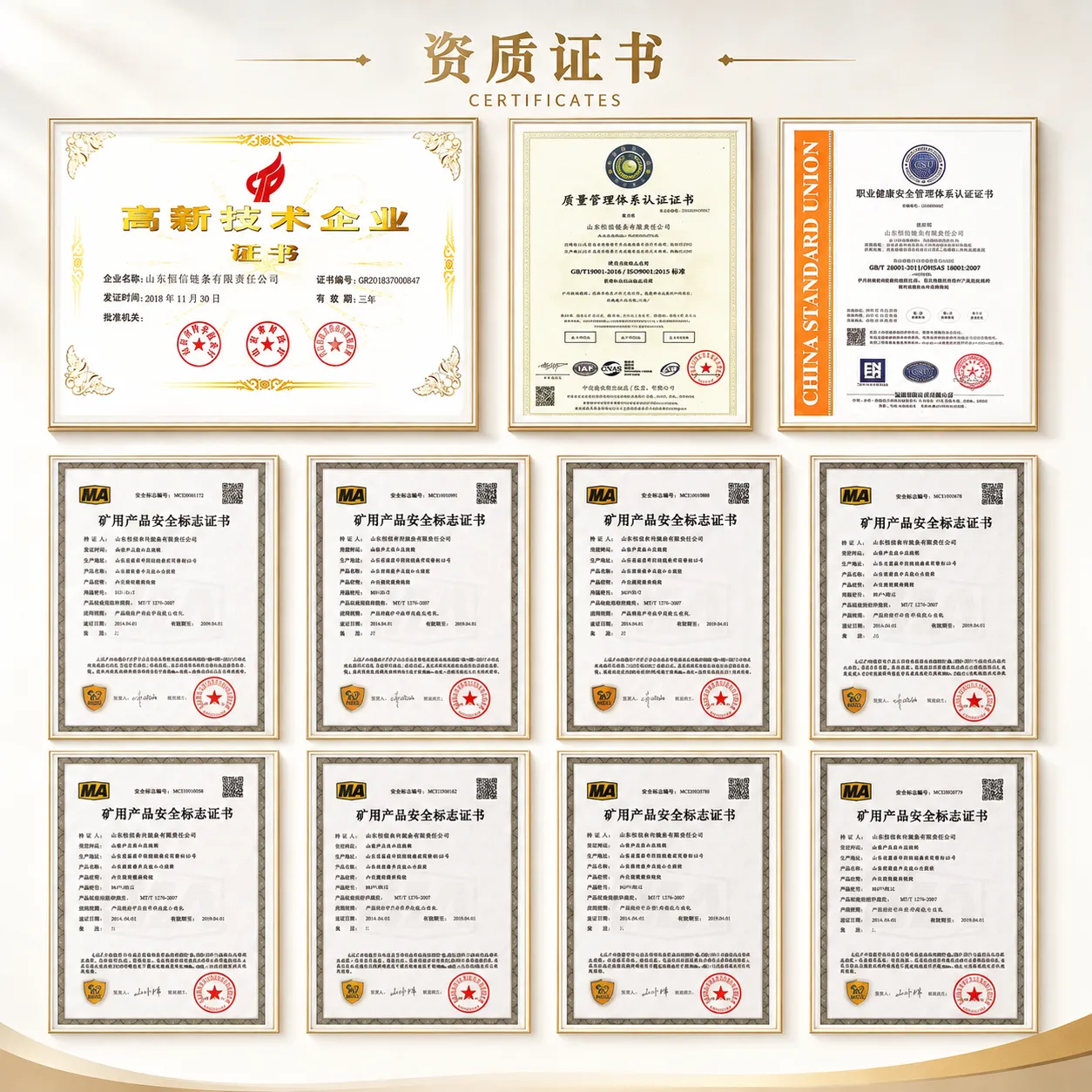
Standard: GB/T 12718 | ISO 9001 · ISO 14001 · CE Mark · MA Mining Safety · Lloyd’s Register · DNV
Product Overview
Round Link Chain for Submerged Slag and Ash Handling
Slag conveyor chains are round link chains designed for submerged scraper conveyors (捞渣机) used in bottom ash and slag extraction from coal-fired power stations, industrial boilers, and furnace plant. Operating conditions combine high temperature, wet abrasive slag, and continuous heavy-load cycling — requirements that differ significantly from standard mining or lifting chain duty.
Ever-power Engineer Class Chain Co., Ltd manufactures slag conveyor chains to GB/T 12718, available in Grade B Und Grade C, covering diameters from 14 to 30 mm. Minimum breaking loads range from 190 kN (14 mm Grade B) to 1,130 kN (30 mm Grade C). Minimum elongation at break is 10% across all sizes and grades.
Chain dimensions are matched to standard submerged scraper conveyor trough profiles. Multiple size combinations are available within the same nominal diameter to accommodate specific equipment configurations from different conveyor manufacturers.
Technical Data
Dimensional & Load Specifications
Reference standard: GB/T 12718 | Dimensions in mm · Weight in kg/m · Breaking loads in kN · Min. elongation at break: 10%
Multiple inner length variants at the same diameter accommodate different conveyor trough configurations · Min. elongation at break: 10% (all sizes and grades)
Construction & Standards
Produktmerkmale
Standard: GB/T 12718All slag conveyor chains are manufactured and tested to GB/T 12718, the Chinese national standard covering dimensional tolerances, mechanical property requirements, and acceptance test procedures for mining and industrial round link chains used in scraper conveyor applications. | Grade B and Grade CGrade B provides the standard breaking load for each diameter. Grade C provides a higher breaking load — approximately 25–35% above Grade B at the same size — for heavier duty or higher-throughput slag extraction systems. Both grades carry a minimum elongation at break of 10%. |
Multiple Profile Variants per DiameterAt 22 mm, 26 mm, and 30 mm nominal diameter, two or three inner length and inner width combinations are available. This accommodates the dimensional requirements of different submerged scraper conveyor manufacturers without requiring custom chain production. | Designed for Wet Abrasive Slag DutySlag conveyor chains operate submerged in water containing abrasive ash particles at elevated temperatures. The alloy steel composition and heat treatment specification are selected to provide adequate wear resistance and fatigue life under these continuous wet abrasive load conditions. |
Size Range: 14 to 30 mmTwelve size-profile combinations from 14 mm to 30 mm diameter cover the range of submerged scraper conveyors used in coal-fired power station bottom ash systems, from smaller boiler units through to large utility-scale generating plant. | Compatible with Scraper Flight AssembliesSlag conveyor chains are dimensioned to be compatible with standard scraper flight bar and trough assemblies used in submerged chain conveyors. Chain dimensions should be verified against the equipment manufacturer’s specification before ordering to confirm interchangeability. |
Häufig gestellte Fragen
Häufig gestellte Fragen
What is a slag conveyor chain used for?
Slag conveyor chains (捞渣机链条) are round link chains used as the traction element in submerged scraper conveyors (捞渣机). These conveyors extract bottom ash and slag from water-filled hoppers beneath coal-fired boilers, industrial furnaces, and waste incineration systems, conveying the wet ash to a discharge point for disposal or reuse.
What is the difference between Grade B and Grade C?
Grade C provides a higher minimum breaking load than Grade B at the same nominal diameter. For example, at 26 mm diameter, Grade B breaking load is 670 kN and Grade C is 850 kN. Grade C is specified for higher-throughput systems or where a greater safety margin is required. Both grades carry a minimum elongation at break of 10%.
Why are there multiple profile variants at the same nominal diameter?
Different submerged scraper conveyor manufacturers use different trough widths and scraper pitch dimensions at the same nominal chain diameter. Multiple inner length and inner width combinations are available at 22 mm, 26 mm, and 30 mm to match specific equipment makes without requiring custom chain production.
Is slag conveyor chain the same as mining round link chain?
Both are round link chains manufactured to GB/T 12718, and their dimensional and load specifications overlap. However, slag conveyor chains are specifically dimensioned for submerged scraper conveyor applications where the trough geometry and scraper attachment points differ from those of coal face armoured face conveyors. Please verify dimensions against your specific equipment before ordering.
What information is needed to confirm the correct chain specification?
To confirm the correct specification, please provide: nominal chain diameter, inner length, inner width, required grade (B or C), quantity, and if possible the conveyor manufacturer and model designation. This allows confirmation of the correct profile variant before production.
Also from Ever-power
Verwandte Produkte
Mining Chains DIN 22252 · Grade B/C · 10×40 to 42×146 mm · armoured face conveyors and scraper systems | Mining Chains GB/T 12718 · Grade C/D · 22×86 to 60×197 mm · compact-profile scraper conveyors |
Mining Accessories Central Chain Scraper Flight Bar Compatible with 22×86 to 42×146 mm chain · matched to conveyor trough dimensions | Mining Accessories Round Link Chain Connecting Links Flat-arc and flat-saw-tooth types · 18×64 to 48×152 mm |
Specialty Chains 304 / 316 / 2520 · 2–32 mm · high-temperature and corrosion-resistant conveyor applications | Lifting Chains EN 818-2 · 6–48 mm · maintenance lifting in power station and industrial plant |
Slag conveyor chains are part of a wider category of industrial round link chain products for power generation and process plant material handling. Those specifying chain for coal handling or ash disposal systems may also find reference in conveyor chain selection and load rating guidance Und power transmission chain standards relevant to adjacent plant drives. For heavy-duty chain products used in connected infrastructure, heavy-duty chain engineering data Und industrial roller chain specifications provide complementary technical context.
Anwendungen der Ingenieur-Klassenkette
Die speziell entwickelte Kette ist ein robustes Arbeitstier, ideal für hohe Traglasten in vielen industriellen Anwendungen, die auch unter rauen Betriebsbedingungen eingesetzt werden. Sie bietet zudem eine hohe Dauerfestigkeit für nahezu kontinuierlichen Betrieb. Sie müssen sich keine Sorgen um Geräteausfälle aufgrund mangelnder Leistung oder durch Überbeanspruchung verursachte Schäden machen. Speziell entwickelte Ketten sind vielseitig einsetzbar und bewähren sich in der Lebensmittelindustrie sowie in einigen der anspruchsvollsten Bereiche weltweit, wie z. B. bei Ölbohrungen, Gabelstaplern, in der Holzverarbeitung, bei Straßenkränen und Aufzügen. Obwohl diese Anwendungen oft mit hohen Temperaturen und großen Mengen an Sand, Schmutz, Fett und Öl einhergehen, meistern speziell entwickelte Ketten diese Aufgaben dank hoher Kraftübertragung und unübertroffener Langlebigkeit. Speziell entwickelte Ketten sind die optimale Wahl, wenn Ihr Unternehmen schwere Ausrüstung bewegen und hohen Stoßbelastungen standhalten muss.
Anwendungsbereiche von Ketten in der Ingenieurstechnik
Die Gastronomie ist nur ein Anwendungsgebiet dieser multifunktionalen Antriebsketten. Sie kommen in anspruchsvollsten Bereichen zum Einsatz, beispielsweise bei Ölbohrungen und anderen Arbeiten mit großen Mengen an Sand, Erde und zähflüssigem Rohöl. Auch Gabelstapler, die wiederholten Belastungen und Stößen ausgesetzt sind, werden mit diesen Ketten betrieben. Antriebsketten sind die erste Wahl für Ingenieure, wenn es auf geringen Platzbedarf, maximale Kraftübertragung und hohe Belastbarkeit ankommt.