
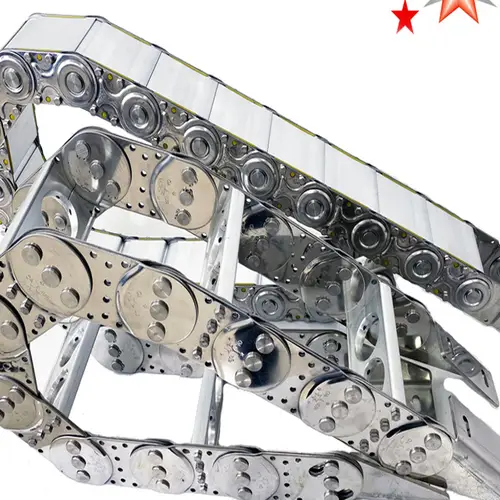
Heavy Duty Steel Cable Drag Chains for Industrial Use
Our Heavy Duty Steel Cable Drag Chains are the most reliable and efficient solutions for guiding, containing, and protecting electrical cables, oil pipes, and hoses during machine movement. These cable carriers are designed for dynamic applications between fixed and moving portions of the machine, helping to reduce wear on cables and tubes, prevent cable entanglement, and improve machine operation and appearance.
What are Steel Cable Chains?
Steel Cable Chains are chains that are used to guide and protect cables, oil pipes, and hoses during machine movement. These chains can be used in dynamic applications between fixed and moving portions of the machine. The use of cable chains can help improve the operation and appearance of the machine, prevent cable entanglement, and reduce wear on cables and tubes.
How to Choose the Right Cable Chain?
The inner height of the cable chain should be taken as the most thick piece of the internally installed cable, oil pipe, gas pipe, or water pipe as the reference height plus 10% of the space height at least as the inner height. If overlapping, take the overlapped height as the actual height. The inner width should be taken as the sum of the outside diameter of the thicker cables, oil pipe, gas pipe, or water pipe as the reference of the inner width and leave at least 10% of the space as a margin. The radius of a bend should be taken as the biggest radius of a bend of a cable, oil pipe, gas pipe, or water pipe as a reference value and leave 10% of the space as a margin.
Construction of the Cable Chain
The cable chain looks like the crawler of a tank consisting of a certain number of joints. The joints of the crawler are freely turned round. The same series of chain has the same inner height and outer height and same pitch, but the inner width and bend radius (R) can be made per different specifications. A unit chain joint consists of a left-right chain plate and an up-down cover. Each chain joint can be opened up so as to facilitate assembly and dismantling without threading. Cables, oil pipes, and gas pipes can be put into the drag chain after the cover plate is opened. Spacers are available for use, which are able to divide the space inside the chain into divisions according to requirements.
Product Parameters
| Size | Pitch | Bending radius | Inside Height | Outside height | Inside Min-width | Inside Max-hole | Edge thickness |
|---|---|---|---|---|---|---|---|
| TL45 | 45 | 50/75/90/114/145 | 16 | 32 | 35 | 18 | 8 |
| TL65 | 65 | 75/90/115/125/145/185 | 25 | 44 | 50 | 30 | 8 |
| TL80 | 80 | 100/115/125/145/185/200/250/300 | 32 | 56 | 55 | 35 | 8 |
| TL95 | 95 | 115/145/200/250/300 | 48 | 70 | 60 | 48 | 10 |
| TL115 | 115 | 145/200/225/250/300/350 | 58 | 86 | 70 | 63 | 11 |
| TL125 | 125 | 200/250/300/470/500/575/600/700/750 | 68 | 100 | 80 | 68 | 12 |
| TL155 | 155 | 250/300/350/450/490/600/650 | 86 | 120 | 90 | 97 | 13 |
| TL180 | 180 | 250/300/350/450/490/600/650 | 112 | 144 | 100 | 110 | 14 |
| TL225 | 225 | 400/450/600/750/800/850/1000 | 165 | 200 | 160 | 146 | 14 |
| TL250 | 250 | 400/450/500/600/750/800/1000 | 187 | 220 | 190 | 166 | 16 |
In addition to our Heavy Duty Steel Cable Drag Chains, EVER-POWER GROUP also offers a wide range of industrial products, including agricultural gearboxes, power output shafts, sprockets, fluid couplings, worm gear reducers, gears and racks, engineering chains, pulleys and pulleys, planetary gearboxes, timing pulleys, bushings, and more. Our products are of high quality, offered at preferential prices, and come with considerate services. We welcome customers to customize drawings and samples for their specific needs.
FAQs
1. What are Steel Cable Chains used for?
Steel Cable Chains are used to guide, contain, and protect electrical cables, oil pipes, and hoses during machine movement. These chains can be used in dynamic applications between fixed and moving portions of the machine, helping to reduce wear on cables and tubes, prevent cable entanglement, and improve machine operation and appearance.
2. How do I choose the right cable chain?
The inner height of the cable chain should be taken as the most thick piece of the internally installed cable, oil pipe, gas pipe, or water pipe as the reference height plus 10% of the space height at least as the inner height. If overlapping, take the overlapped height as the actual height. The inner width should be taken as the sum of the outside diameter of the thicker cables, oil pipe, gas pipe, or water pipe as the reference of the inner width and leave at least 10% of the space as a margin. The radius of a bend should be taken as the biggest radius of a bend of a cable, oil pipe, gas pipe, or water pipe as a reference value and leave 10% of the space as a margin.
3. How are the cable chains constructed?
The cable chain looks like the crawler of a tank consisting of a certain number of joints. The joints of the crawler are freely turned round. The same series of chain has the same inner height and outer height and same pitch, but the inner width and bend radius (R) can be made per different specifications. A unit chain joint consists of a left-right chain plate and an up-down cover. Each chain joint can be opened up so as to facilitate assembly and dismantling without threading. Cables, oil pipes, and gas pipes can be put into the drag chain after the cover plate is opened. Spacers are available for use, which are able to divide the space inside the chain into divisions according to requirements.
4. What other industrial products does EVER-POWER GROUP offer?
In addition to our Heavy Duty Steel Cable Drag Chains, EVER-POWER GROUP also offers a wide range of industrial products, including agricultural gearboxes, power output shafts, sprockets, fluid couplings, worm gear reducers, gears and racks, engineering chains, pulleys and pulleys, planetary gearboxes, timing pulleys, bushings, and more.
5. Can I customize drawings and samples for my specific needs?
Yes, we welcome customers to customize drawings and samples for their specific needs.
All the content of this page is from the Internet, the content is only as a reference for product selection, our products are replacement parts and not original spare parts; we are not the holder of the original trademarks of the content, our products are only suitable for after-sales replacement parts and not original spare parts, our replacement parts can be perfectly adapted to the original spare parts; if you need to buy original spare parts, please contact the original factory to buy. if you want to buy original spare parts, please contact the original supplier for purchase.
Performance Characteristics of Engineering Chain
Engineering chains are widely used in various industries due to their exceptional performance characteristics. These include high strength, durability, resistance to wear and tear, and low maintenance.
Types and Characteristics of Engineering Chain
Engineering chains can be classified based on their structure, uses, and materials. The different types of engineering chains include roller chains, conveyor chains, leaf chains, and specialty chains. Each type has its unique characteristics that make it suitable for specific uses and applications. For instance, roller chains are commonly used in drive systems due to their high efficiency, while conveyor chains are ideal for use in material handling due to their durability and resistance to wear and tear.
Advantages of Engineering Chain Made of Different Materials
Engineering chains can be made from different materials such as stainless steel, carbon steel, and plastic. Each material has its distinct advantages, making it suitable for specific applications. For instance, stainless steel chains are highly resistant to corrosion and suitable for use in harsh environments, while plastic chains are lightweight and ideal for use in places where noise reduction is essential.
Applications of Engineering Chain
Engineering chains find extensive use in various industries such as Conveyor Systems, Material Handling, Drive Systems, Automated Car Parking Systems, Mining, and Quarrying. Their exceptional performance characteristics make them ideal for use in these fields, and they have proven to be invaluable in improving the efficiency and productivity of these industries.
Future Development Trends and Opportunities of Engineering Chain Products
The future of engineering chain products looks promising, with significant opportunities for growth and development. The increasing demand for automation and technological advancements in different industries is driving the demand for engineering chains. With the rise of smart factories and Industry 4.0, there is a need for high-performance engineering chains that can withstand the rigors of automated manufacturing processes.
How to Choose a Suitable Engineering Chain
Choosing a suitable engineering chain requires an understanding of the application requirements, the type of chain needed, the chain material, and compatibility with sprockets. The application requirements will help determine the type of chain needed, while the chain material will depend on the environment in which the chain will be used. Checking compatibility with sprockets is essential to ensure optimal performance and to avoid premature wear and tear.
Conclusion
In conclusion, engineering chains are an essential component in various industries, and their exceptional performance characteristics make them invaluable in improving the efficiency and productivity of these industries. Choosing a suitable engineering chain requires a good understanding of the application requirements, type of chain, material, and compatibility with sprockets.
Author: Dream