
Rooftop Transfer Chains
As one of the engineer class chain manufacturers, suppliers, and exporters of mechanical products, We offer engineer class chain and many other products.
Please get in touch with us for details.
Mail:[email protected]
Roof conveyor chains are special chains for moving bulk materials. They are also known as humpback chains or transfer chains. This type of chain was introduced after the invention of the H-mill chain to enhance bulk material handling and transfer in the aggregate and forestry industries. Today, roof conveyor chains can be found in virtually every industry and application requiring a high-strength conveyor chain. Our roof chains are known for their ability to withstand the toughest applications and offer a variety of features and benefits.
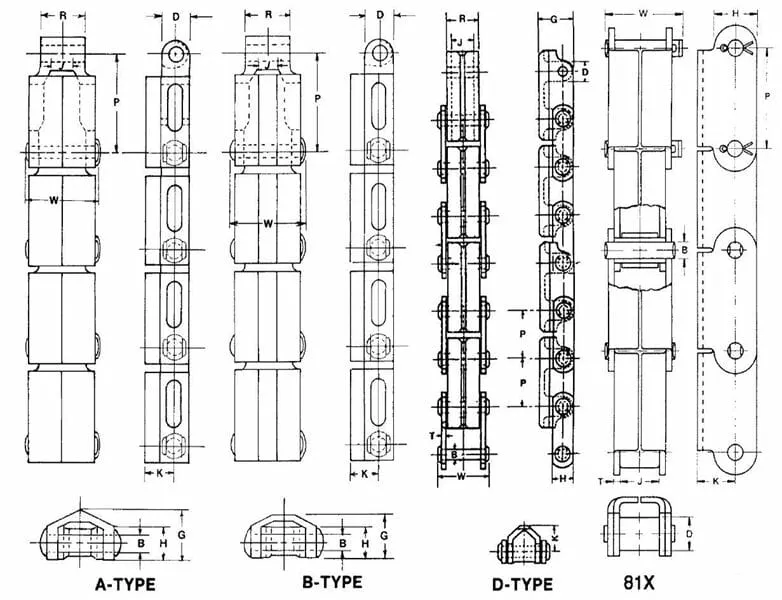
Uses of Rooftop Transfer Chains
Roof conveyor chains are most commonly used to run in troughs in two or more parallel supports on a conveyor, with only the beveled tops of the links protruding around the rails. This allows lateral loading and unloading. The name “humpback chain” is used for this type of chain because of its ability to carry heavy concentrated loads, handle bulk materials, and transport products. In industry, roof conveyor chains are the material of choice for carrying and transporting lumber, boxes, barrels, crates, parcels, barrels, rods, and more.
Roof conveyor chains run in one direction and are therefore not recommended for installations requiring reverse run. The speed of operation is determined by the load carried and the frequency of operation. Typically, the recommended speed is 100 feet per minute.
| Part No. | H78 | H130 | H138 | C55 | 81X |
| Industry No. | 130 | 141 | 143 | 149 | 154 |
| Pitch (P) | 2.609 | 4.000 | 4.000 | 1.631 | 2.609 |
| Rooftop Style | A | A | B | D | – |
Applications of Engineering Class Chain
The engineered chain is a solid workhorse, ideal for high load capacities for many industrial applications that include or require harsh operating conditions. The engineered chain also provides fatigue strength for near-continuous operation. You don’t have to worry about stopping equipment due to poor performance or continuing equipment failure due to overuse. Engineering chains are versatile, working in the food service industry and some of the most challenging jobs on the planet, such as oil drilling, forklift operations, timber applications, road cranes, and elevators. While these applications are often harsh with high temperatures and volumes of sand, dirt, grease, and oil, engineered chains get the job done with high power transfer rates and unmatched durability. Engineered chains are a natural choice when your organization is looking for something to move heavy equipment and handle high shock loads.
Uses of Engineering Class Chains
Food service is just one of many applications of this type of multifunctional engineering chain. They are used in some of the toughest applications, such as oil drilling, operations involving large amounts of sand, dirt and sticky crude. They also saw the use of forklifts that would be subjected to repeated stress and bumps. Engineering chains are the engineer’s first choice when the application requires compact space, the maximum possible amount of power transfer and a high level of durability.