Hatch Cover Chain – 11–30 mm | Test Load 57–399 kN | Lloyd’s ABS DNV Certified
As one of the engineer class chain manufacturers, suppliers, and exporters of mechanical products, We offer engineer class chain and many other products.
Please get in touch with us for details.
Mail:[email protected]
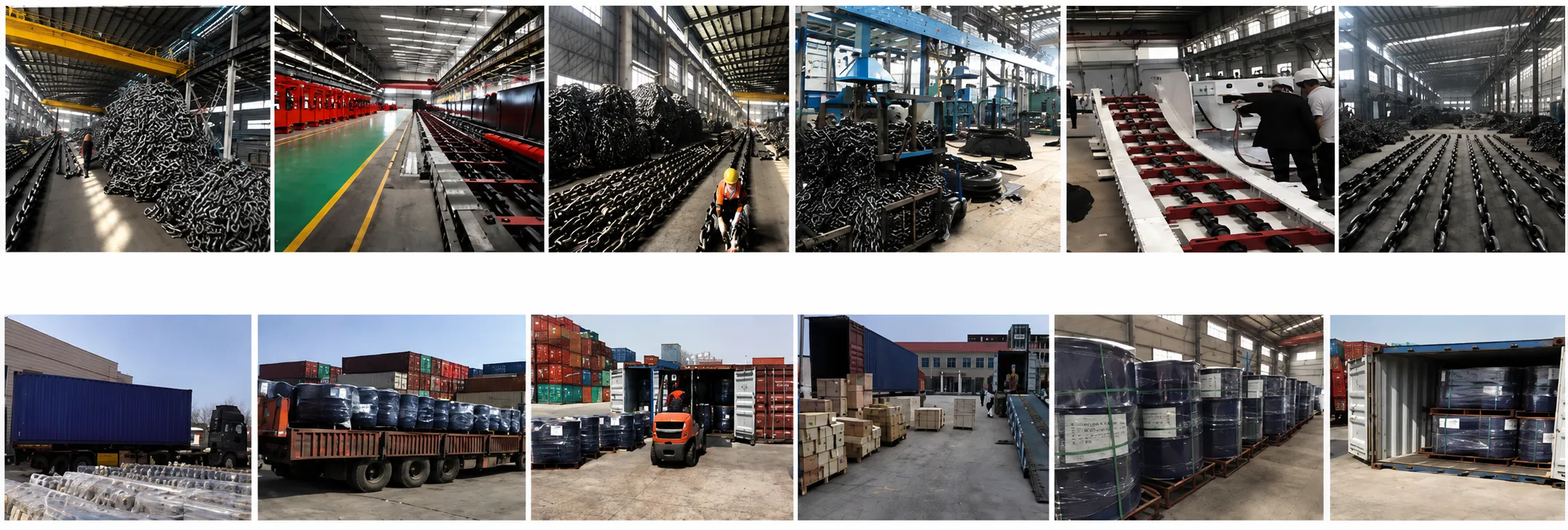
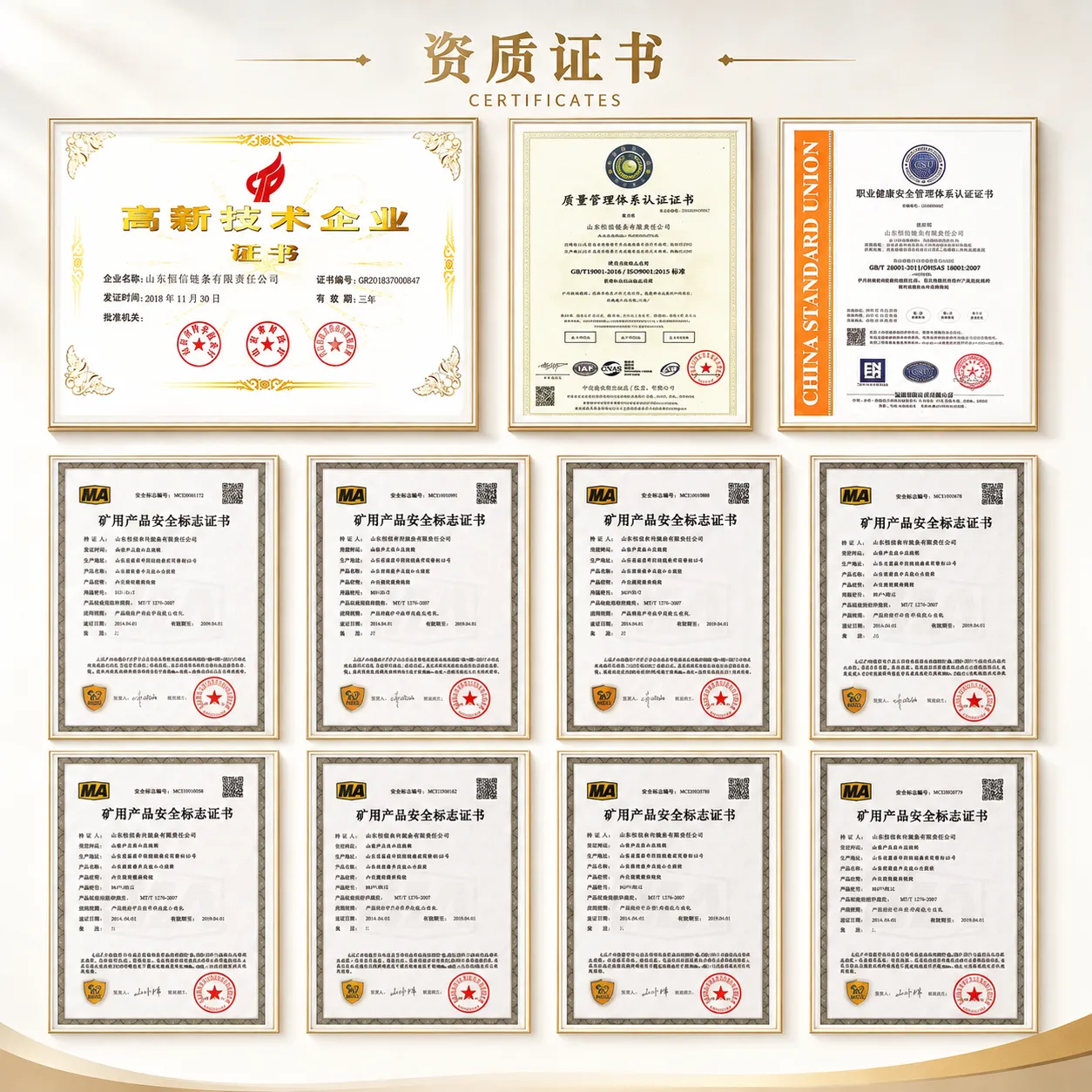
Certified by | Lloyd’s Register · ABS · Bureau Veritas · DNV · ISO 9001 · ISO 14001 · CE Mark
Product Overview
Short-Link Chain for Vessel Hatch Cover Systems
Hatch cover chains are short-link round steel chains used in the lifting, positioning, and securing mechanisms of vessel hatch covers on cargo ships, bulk carriers, container vessels, and general-purpose merchant shipping. The chain connects hatch cover panels to the actuating hardware and provides the structural link between the cover and the vessel deck fitting.
Ever-power Engineer Class Chain Co., Ltd supplies hatch cover chains in 14 standard size-profile combinations from 11 to 30 mm diameter, with test loads from 57 kN to 399 kN and breaking loads from 116 kN to 798 kN. Multiple inner length and inner width variants are available at key diameters — 14 mm, 16 mm, 18 mm, 20 mm, and 22 mm — to match specific hatch cover equipment manufacturers’ dimensional requirements.
Classification society certificates from Lloyd’s Register, ABS, Bureau Veritas, and DNV are available for each shipment. Chains are produced from alloy steel with surface treatment suited to the marine environment.
Technical Data
Dimensional & Load Specifications
Dimensions in mm · Loads in kN · Weight in kg/m · A/B variants denote different inner length and width profiles at the same nominal diameter
A / B / C variants at the same nominal diameter denote different inner length and inner width profiles · Dimensions should be verified against hatch cover equipment specification before ordering
Construction & Design
Product Features
Multiple Profile Variants per DiameterAt 14 mm, 16 mm, 18 mm, 20 mm, and 22 mm nominal diameter, two or three inner length and inner width combinations are available. The 22 mm size has three variants (A, B, C) to accommodate the range of hatch cover hardware configurations used by different vessel builders and equipment manufacturers. | Size Range: 11 to 30 mmFifteen standard size-profile combinations from 11 mm to 30 mm cover the range of hatch cover systems used on coastal and ocean-going cargo vessels, bulk carriers, and general-purpose merchant ships. The 30 mm size with a breaking load of 798 kN covers heavy hatch cover applications on larger bulk carriers. |
Test Loads 57–399 kN · Breaking Loads 116–798 kNAll chains are proof tested before dispatch. Test loads range from 57 kN (11 mm) to 399 kN (30 mm). Minimum breaking loads are approximately twice the test load across all sizes, providing a defined margin above the proof test level. | Classification Society CertifiedChains can be supplied with certificates from Lloyd’s Register, ABS, Bureau Veritas, or DNV. Classification society certification is typically required by vessel operators and shipyards for hatch cover chain replacement. Please specify the required society at the time of enquiry. |
Alloy Steel — Marine Grade Surface TreatmentChains are manufactured from alloy steel with surface treatment suited to the marine environment. Hot-dip galvanising or painting options are available depending on the exposure conditions and replacement interval requirements of the specific hatch cover installation. | Dimension Verification Before OrderingHatch cover chain dimensions vary between vessel designs and hatch cover manufacturers. Before placing an order, the nominal diameter, inner length, inner width, and required test/breaking load should be confirmed against the vessel’s maintenance records or hatch cover equipment documentation to ensure the correct variant is supplied. |
FAQ
Frequently Asked Questions
What information do I need to order the correct hatch cover chain?
Please provide the nominal diameter, inner length, and inner width of the existing chain, along with the vessel name, hatch cover manufacturer and type if known, and the required classification society certificate. This allows confirmation of the correct profile variant (A, B, or C at diameters where multiple profiles exist) before production.
Why are there multiple profile variants at the same nominal diameter?
Different hatch cover equipment manufacturers — including MacGregor, Hatlapa, and others — use different inner link dimensions at the same nominal chain diameter to suit their specific sheave, guide, and connecting hardware dimensions. Multiple variants allow direct replacement without modification to the hatch cover system.
What is the breaking load for 22 mm hatch cover chain?
All three 22 mm variants (A, B, and C) carry the same breaking load of 480 kN with a test load of 240 kN. The difference between variants is the inner length and inner width — A: 78×31 mm, B: 86×30 mm, C: 66×31 mm — which affects compatibility with the hatch cover hardware rather than the load capacity.
Is a classification society certificate required for hatch cover chain replacement?
Classification society certification is typically required by vessel operators and shipyards for hatch cover chain replacement on classed vessels. The specific society (Lloyd’s, ABS, BV, DNV) should match the vessel’s class. Please specify the required society at the time of enquiry so the correct test and documentation procedure is followed.
What surface treatment is available for hatch cover chains?
Hot-dip galvanising and painting are the standard surface treatment options for hatch cover chains. The appropriate treatment depends on the hatch cover system design, accessibility for maintenance, and the vessel’s trading route. Please specify at enquiry stage.
Also from Ever-power
Related Products
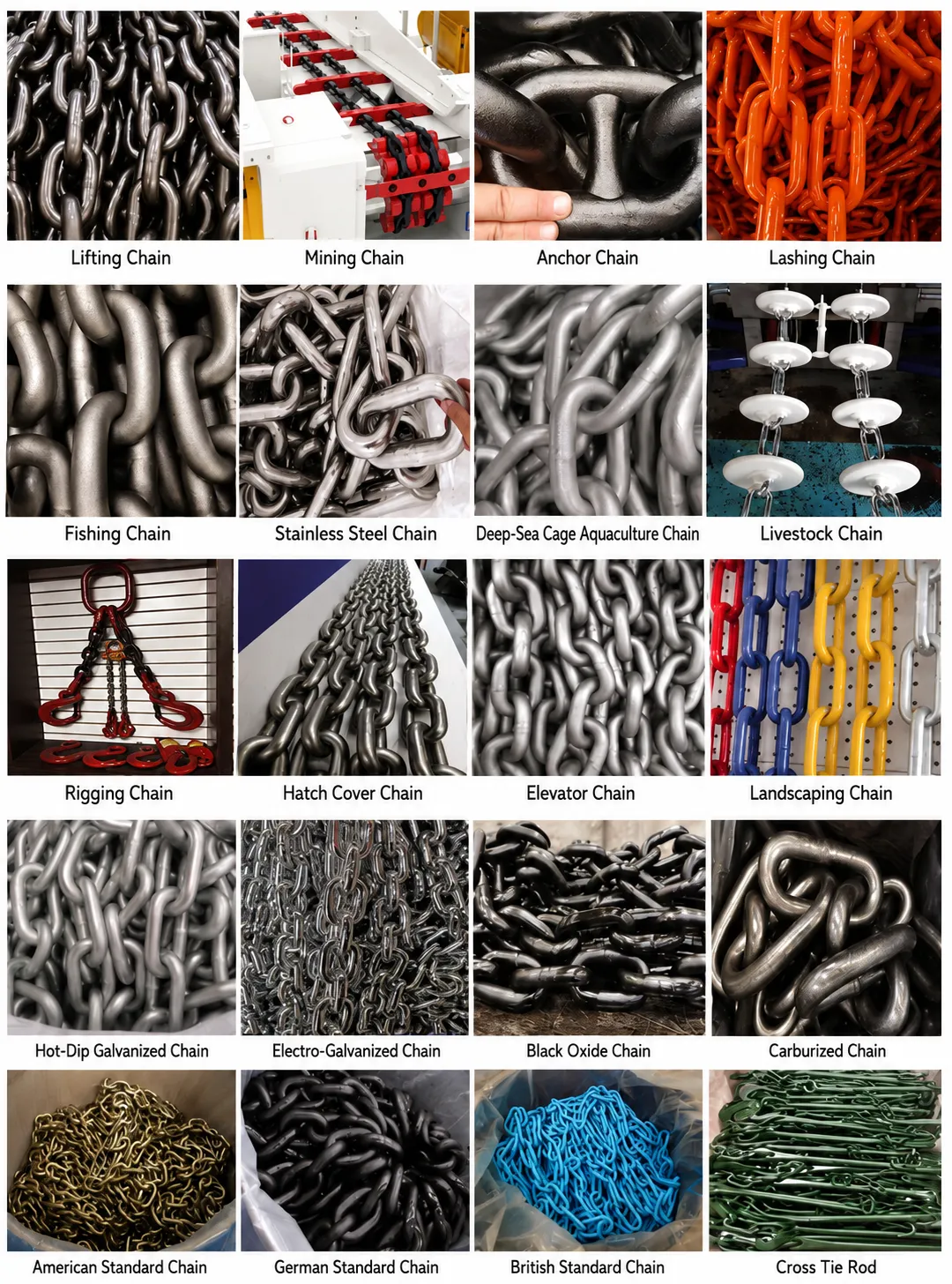
Marine & Anchor Chains ISO 1704 · Grade U1/U2/U3 · stud and studless · 20–150 mm · commercial shipping | Marine & Anchor Chains 304 / 316 stainless or galvanised · 7–28 mm · vessel deck and mooring applications |
Lifting Chains EN 818-2 · 6–48 mm · port crane and vessel maintenance lifting | Rigging Hardware Bow and D-type · 3/16 to 2-1/2 in · hatch cover and deck rigging connections |
Specialty Chains 304 / 316 / 316L · 2–32 mm · corrosion-resistant marine deck applications | Rigging Hardware Grab hooks and clevis hooks · 1/4 to 3/4 in · deck and hatch cover rigging |
Hatch cover chains are part of a wider category of marine chain and deck hardware products. Those specifying chain for vessel maintenance and port operations may also find reference in heavy-duty chain engineering data and power transmission chain standards for port and shipyard equipment drives. For corrosion-resistant chain products suitable for marine environments, flexible chain system specifications and industrial roller chain specifications provide complementary technical context.
Applications of Engineering Class Chain
The engineered chain is a solid workhorse, ideal for high load capacities for many industrial applications that include or require harsh operating conditions. The engineered chain also provides fatigue strength for near-continuous operation. You don’t have to worry about stopping equipment due to poor performance or continuing equipment failure due to overuse. Engineering chains are versatile, working in the food service industry and some of the most challenging jobs on the planet, such as oil drilling, forklift operations, timber applications, road cranes, and elevators. While these applications are often harsh with high temperatures and volumes of sand, dirt, grease, and oil, engineered chains get the job done with high power transfer rates and unmatched durability. Engineered chains are a natural choice when your organization is looking for something to move heavy equipment and handle high shock loads.
Uses of Engineering Class Chains
Food service is just one of many applications of this type of multifunctional engineering chain. They are used in some of the toughest applications, such as oil drilling, operations involving large amounts of sand, dirt and sticky crude. They also saw the use of forklifts that would be subjected to repeated stress and bumps. Engineering chains are the engineer’s first choice when the application requires compact space, the maximum possible amount of power transfer and a high level of durability.