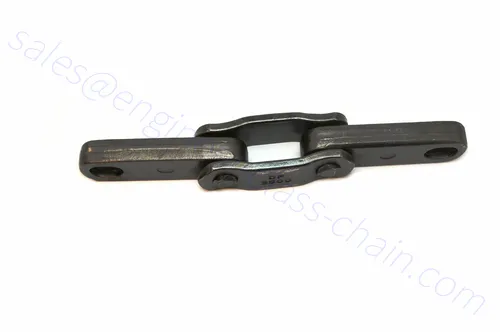
Case Conveyor Chain
As one of the engineer class chain manufacturers, suppliers, and exporters of mechanical products, We offer engineer class chain and many other products.
Please get in touch with us for details.
Mail:[email protected]
A case conveyor chain is a type of conveyor chain used primarily in packaging and material handling applications. It is suitable for moving heavy items or boxes from one place to another in a manufacturing plant or warehouse setting. Typically made from steel or stainless steel, case conveyor chains are strong, durable, and resistant to wear and tear. They can be configured in a number of ways, including straight, curved, or inclined, depending on the requirements of the application. Some common features of a case conveyor chain include a series of interlocking metal links, sprockets to drive the chain, and a variety of optional attachments such as cleats or pushers to assist with moving the load.

| Part No. | 3498 | 3500 |
| PEER Part No. | 3500 | |
| Industry No. | 3498 | 2.500 |
| Lacing | 3.000 | |
| Pitch Inner Link (P) | 1.750 | |
| Pitch Outer Link (P) | 2.500 | 0.561 |
| Pin Diameter (D) | 0.625 | |
| Block Link Inside Width Sprocket Contact (R) | 1.250 | |
| Roller Diam. (D) | 1.500 | |
| Roller Diam. (R) | 20 | |
| Roller Diam. (W) | 0.624 | |
| Width Inside (E) | 0.250 | |
| Plate Height (H) | 1.400 | |
| Overall Length Over Rivit Length | in | |
| Chain Width Overall (G) | 1.480 | |
| Min Flex Radius (R) | 20 | |
| Chain Width Inside Link (W) | 0.640 | 48000 |
| Plate Thickness (T2) | 3.290 | |
| Plate Thickness (T) | 0.310 | |
| Unit of Measure (Inches or Millimeters) | in | |
| Avg. Tensile Strength (R) | 50000 | |
| Weight Per Foot Lbs. | 3.900 |
Applications of Engineering Class Chain
The engineered chain is a solid workhorse, ideal for high load capacities for many industrial applications that include or require harsh operating conditions. The engineered chain also provides fatigue strength for near-continuous operation. You don’t have to worry about stopping equipment due to poor performance or continuing equipment failure due to overuse. Engineering chains are versatile, working in the food service industry and some of the most challenging jobs on the planet, such as oil drilling, forklift operations, timber applications, road cranes, and elevators. While these applications are often harsh with high temperatures and volumes of sand, dirt, grease, and oil, engineered chains get the job done with high power transfer rates and unmatched durability. Engineered chains are a natural choice when your organization is looking for something to move heavy equipment and handle high shock loads.
Uses of Engineering Class Chains
Food service is just one of many applications of this type of multifunctional engineering chain. They are used in some of the toughest applications, such as oil drilling, operations involving large amounts of sand, dirt and sticky crude. They also saw the use of forklifts that would be subjected to repeated stress and bumps. Engineering chains are the engineer’s first choice when the application requires compact space, the maximum possible amount of power transfer and a high level of durability.